Another year has slipped away and countless dreams, goals, and ambitions gather dust in places just beyond the reach of a man's will.
For every one achiever who has found the time—many lose it or never had it in hand to begin with. And even the achiever himself sacrifices time and attention at large to realize the singular gain.
Yet what is time? Can it really be found and lost? Is it truly the commodity we perceive it to be? Time respects no man, cannot be tethered to a place, but inhabits all of and every space.
Time is this moment, and the next, strung together in an endless conduit; and in the same way I can no longer experience the moments that have passed—no matter how immediate or how far removed—you cannot hold anything of the future except what becomes this present moment.
If time is a dimension in the same order as space then accessing anything but Now is the singular priviledge of the Eternal. For the One who exists outside of time the past, the present, and the future are held in hand much as a block of wood is in mine—available for immediate, and endless, and simultaneous examination. Oh, pity the man who would attain immortality but remain chained to the here and now.
Thus I exist in a duality. My quest is both to cherish and own each moment, yet grow in my anticipation of being released from the shackles of the Present.
Born selfish. We all are. Some of us outgrow some of it easier than others. Confusion and Hurts hunt us through our formative years. Defense mechanisms partner with our selfishness and raise up strongholds in the intimate recesses of the soul.
Moments of joy and bliss imprint themselves onto our personalities. The love we do experience, gently coaxes us to leave the protection of our fortresses behind. If there's enough love over enough time some of us oblige; if not—love may be shut out forever.
Our strongholds turn into prisons—and the diversions we turn to ensnare us. Held hostage by our fixations we remain oblivious to the reality that the doors of our cells are unlocked and stand agape. During moments of lucidity some of us perceive the freedom that has been purchased for us.
We reach out an eager hand—but freedom demands we let go of the past with the other. Many of us remain paralyzed for years; and unwilling to release our grasp on the injustices of yesteryear we are prevented from embracing the gifts of the manifesting Present.
In the Scriptures, Jeremiah, Hosea, and Jesus himself all spoke of the fallow ground in out hearts. James laments how quickly we lose sight of what we see in the mirror. Neglected parts of our hearts dry out and thorns and thistles creep and cover while we insist on being otherwise occupied.
Unrealized potential, perpetual immaturity—and a squandered life lay in the balance.
"If I find in myself a desire which no experience in this world can satisfy, the most probable explanation is that I was made for another world. If none of my
earthly pleasures satisfy it, that does not prove that the universe is a fraud. Probably earthly pleasures were never meant to satisfy it, but only to arouse it, to suggest the real thing.
If that is so, I must take care, on the one hand, never to despise, or be unthankful for, these earthly blessings, and on the other,
never to mistake them for the something else of which they are only a kind of copy, or echo, or mirage.
I must keep alive in myself the desire for my true country, which I shall not find till after death; I must never let it get snowed under or turned aside; I must make it the main object of life to press on to that other country and to help others to do the same."
C.S. Lewis
Have you ever tried wrestling in your mind with the scope of an expanding Universe? What is at the end of it—is there a boundary or a wall—and if so what occupies the other side? Or have you pondered the implications of a time travelers actions on the time line of human history and how even a butterflies'
wings can play their part in a hurricane? While the steadfast efforts of scientists and mega-computers can help us make inroads with scores of subjects—Eternity is another matter altogether. Again and again it rebuffs the intellects of the finite. And yet where my mind is at its wits end—
my heart registers and resonates Truths that transcend time.
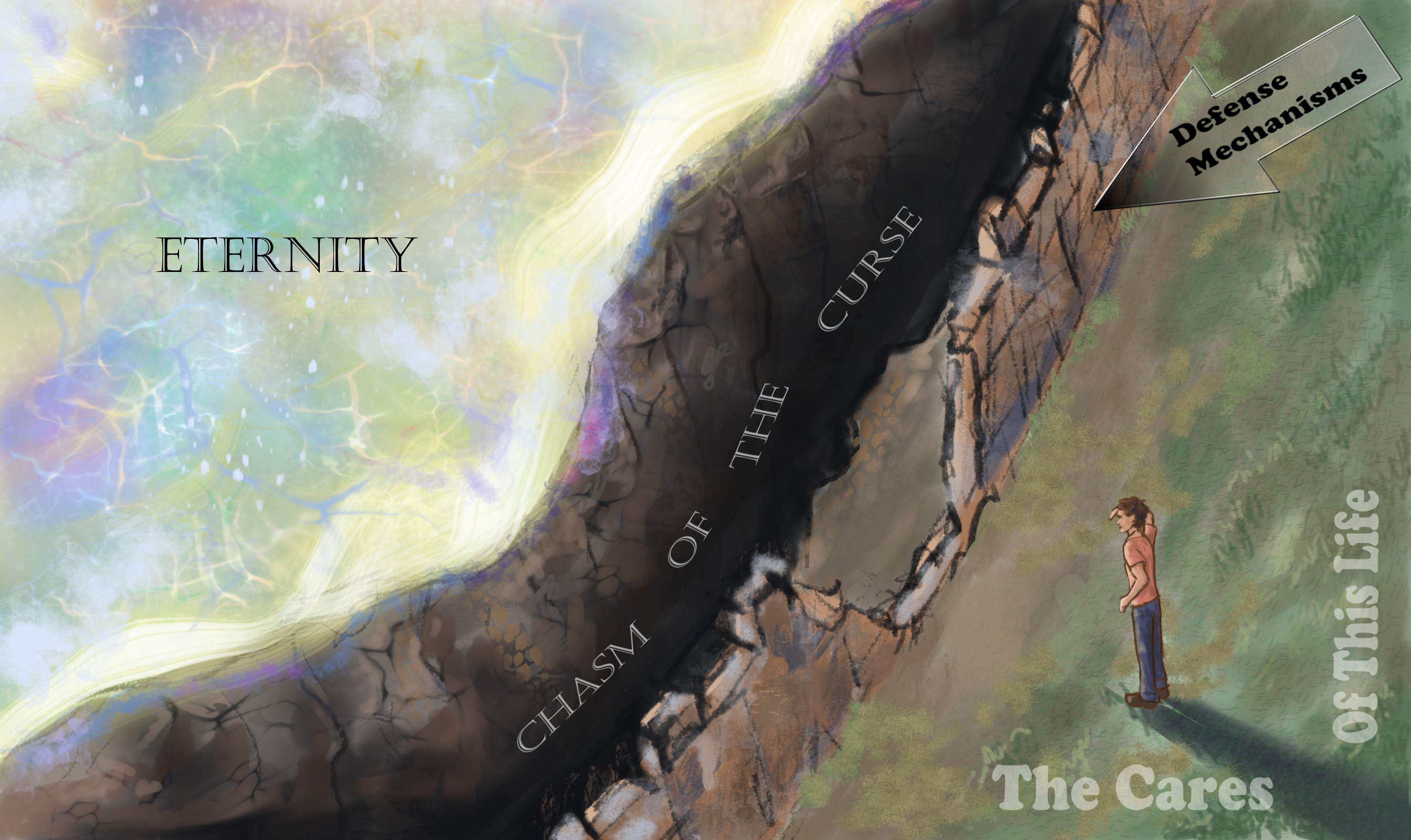
... God Set Eternity In Their Hearts ...
The Gaze of The Soul
It seems that for the young and the old, Eternity looms larger than for those of us preoccupied with the cares of this life. In part, this is due to the mind's inablility to penetrate beyond the scintillating and unbounded face of the Eternal.
Eternity in temporal spaces is undefinable, it is all but incomprehensible. Only those who are willing, recognize that the chambers of the heart echo with truths that defy time.
Defense Mechanisms
Especially during our formative years, defense mechanisms comingle with our instincts to protect the self-life, and walls are built as a result. As we contemplate our lives, these walls can cause us to eliminate Eternity from most all of our calculations.
Missiles of Light
Different events in our lives have the power to breach holes in these walls. The joy of a new life being born, the triumph of good over evil, catastrophes and deaths, all leave their marks. How they affect us beyond the moment, beyond the situation, depends on our response. If we react instinctively, we may plug the gap more securely than before. If we embrace whatever it is, we may respond by tearing down our walls a brick at a time.
Along with my heart, the miracle of life, the structure and beauty of the natural world, the human intellect, and the Word of God allow me to piece together a coherent message of my origins, my purpose, and of a future hope.
Often I encounter parts of the message that have been corrupted, manipulated, and twisted and it becomes difficult to make sense of the pain, the carnage, the isolation and seeming futility of it all.
In his book Mere Christianity, C.S. Lewis offers self-evident truths that help us transcend the fray. And as we shall soon see Evil itself stands as a testimony to Good. However what does Evil consist of and where does it come from? It is first detected in the heart—and with what Lewis has termed The Law of Human Nature. It is the one Law, he states, that provides us with inside information, as all other Natural Laws exist apart from us and we are subject to them—
be it gravity or biology.
Some reduce such notions to a herd instinct reserved for a time and a place as appropriate. Yet while there has been some diversity of values across spans of time and cultures the Truths underpinning them remain constant.
"... fair play or decent behavior or morality or whatever you like to call it, about which they are really agreed. And they have. If they had not, they might, of course, fight like animals, but they could not quarrel in the human sense of the word. Quarreling means trying to show that the other man is in the wrong. And there would be no sense in trying to do that unless you and he had some sort of agreement as to what Right and Wrong are..." (Mere Christianity; P. 4)
To compound the matter eventually I find that whatever standard and principles I consent to abide by—I am incapable of living up to them. Yes there is that same foulness in me that I observe in Creation as a whole.
Good and Evil. Mutually exclusive. Forever battling. "One likes hatred and cruelty—the other love and mercy." (Lewis: Page 42)" Is it a matter of my preference? Because just then, when I call either the one or the other right or wrong—a deeper law yet emerges. And since both powers are subject to this standard, they are subject to the Power that made it so.
Speaking of Good and Evil in these terms is to speak of Dualism. However the problem is that Evil cannot stand on its own two feet. It must love badness to the same degree that the Good Power loves the good. As such it would be incapable of fashioning good things to subsequently corrupt and pervert.
"Put it more simply still. To be bad, he must exist and have intelligence and will. But existence, intelligence and will are in themselves good. Therefore he must be getting them from the Good Power: even to be bad he must borrow or steal from his opponent. And do you now begin to see why Christianity has always said that the devil is a fallen angel? That is not a mere story for the children. It is a real recognition of the fact that evil is a parasite, not an orginal thing.
The powers which enable evil to carry on are powers given it by goodness. All the things which enable a bad man to be effectively bad are in themslves good things—resolution, cleverness, good looks, existence itself. That is why Dualism, in a strict sense, will not work." (Mere Chrisitanity; P. 45)
So Evil personified depends on something good gone wrong. Right and wrong in turn point to an Author. That Author is the—I AM—the Eternal One; one who speaks from beyond time and thus whatever He speaks is eternal.
And if the Author of reality is Good: Then I can trust when He made me it was for His pleasure and that too was good. There have been many creeds in the 2000 years since Jesus Christ, the Son of God, walked the earth. One stands out among the rest: "Man's chief end is to glorify God and to enjoy Him forever!" And so I conclude that I was made: by Joy—for Joy!
Running. I have been running for as long as I can remember. Running from myself. Running to not miss out on the next thing that promises to satiate the unbearable lightness of the holes in my soul.
Relief. Reprieve. A sense of contentment: That all is right with the world (if only for a few moments). Gas in the tank to make it a few hundred feet further down the road. We all have needs. We all have a nature—a human nature.
Not only do the wounds that have yet to heal set me to flight, but especially the unredeemed portions of my soul that remain cowering in the strongholds I erected to preserve them. Oftentimes,
they are sequestered as a reaction to injustice, perceived and real alike. Three distinct yet interconnected causes stand out: Character Defects, Declared Independence, and Performance Anxiety.
Character Defects
Unforgiveness, resentment, and bitterness are common culprits that foul up the character—each exacting their toll on any individual 'unable' to do the required work to clean them out. Treading water on soul work, however, is an illusion as the tides and currents of this fallen world we live in drift us out to sea and compound the issues with interest. Like someone with a spending habit, no income, and making minimum monthly payments on the credit card—unpayble debts ensue.
Declared Independence
Independence and autonomy are a two-faced monster: On the one hand shame masquerading as strength and on the other pride stoking the fires of denial. The illusion of our independence is confirmed by the Scriptures, which illustrate at length our enslavement to sin. Ask any recovering alcoholic and they will you that "pride leading to self-justification, and always spurred by conscious or unconscious fears, is the basic breeder of most human difficulties, the chief block to true progress." (Twelve & Twelve, p. 48-49) They go on to say that pride lures us into making ureasonable demands of ourselves and others. Reduces our existence to obsessing over satisfying our instincs for sex, security, and society—and justifies the resulting excesses.
"All these failings generate fear, a soul-sickness in its own right. Then fear in turn generates more character defects. Unreasonable fear that our instincts will not be satisfied drives us to covet the possessions of others, to lust for sex and power, to become angry when our instinctive demands are threatened, to be envious when the ambitions of others seem to be realized while ours are not. We eat, drink, and grab for more of everything than we need, fearing we shall never have enough. And with genuine alarm at the prospect of work, we stay lazy. We loaf and procrastinate, or at best, work grudgingly and under half-steam. These fears are the termites that ceaselessly devour the foundations of whatever sort of life we try to build." (Twelve & Twelve, p. 49)
Inevitably, we must to the last man, reach that place of recognition regarding our condition as a whole and in each of its many distinctions we subsequently encounter—that our way of thinking and doing does not cut it—it does not work. If we surrender, if we pledge our allegiance to this singular truth that despite our condition God is for us and not against us, we come to a door... "A door which to all appearances is still closed and locked. [Though] all we need is a key, and the decision to swing the door open. There is only one key, and it is called willingness. Once unlocked by willingness, the door opens almost of itself, and looking through it, we shall see a pathway beside which is an inscription. It reads: 'This is the way to a faith that works.'" (Twelve & Twelve, p. 34)
Our pride and fear stand in direct opposition to newfound and often fledgling willingness, willingness to live out our life under new management and as the first order of business to address the calamities of our making. "Pride says, 'You need not pass this way,' and Fear says, 'You dare not look!' [But the testimonies of recovering people everywhere, people who stopped running and faced the music] is that pride and fear of this sort turn out be bogeyman, nothing else." (Twelve & Twelve, p. 49)
Performance Anxiety
Honest efforts of this kind lead to truth—lead to reprieve—and set me on the road to freedom. Were life to become a vacuum at this point the work may be done. But addressing the past merely confirmed my proclivity to lose the straight and narrow way—and clarified that I am the unhappy sap and owner of instincts gone astray.
It's no wonder then that I am anxious about my ability to live life on life's terms. Seeing how I made a mess of things in one or two areas slowly leads to the recognition that the disease of my self-sufficiency affects every nook and cranny of the soul. As life moves on my willingness comes under full attack—"if I am rid of ALL these defects, who will I be? There will be nothing left of Me!" Not confronting this twisted thinking and choosing to believe that I will cease to exist if I attempt to realize my full potential, can perpetuate a cycle—ad nauseum—of reclaiming management of this or that situation until such a time that things come to a head again.
If 'running away from' is my default, and remaining stationary in a dynamic world is not possible, 'running toward' is the only option that leads to life. Outrunning my nature is impossible—accepting and putting on my new nature—secured for me by the blood of Jesus Christ on the cross at Calvary—is not just my last resort—it is the only means of escape from the empty clutches of self and the destined eternal punishment reserved for that ancient serpent and deceiver—Satan—the Author of Lies.